
Supporting Skilled Workers with Self-claimed Verifiable Credentials
Case Studies > LinkedCreds
About The Project
Strategy User Research Design AI Skill Extraction JSON-LD Data Modeling Open Badges W3C Verifiable Credentials Fullstack Engineering JSON-LD API Development Support & Maintenance
.png?width=1920&height=1440&name=LinkedCreds%20(T3).png "LinkedCreds (T3)")
Enable people to document skills gained through work and life experiences by self-asserting those skills and saving them as verifiable credentials.
LinkedCreds is a lightweight authoring tool designed to make it easier for individuals to make skill claims and save them as verifiable credentials without needing complex infrastructure. The project began as a collaboration between multiple partners aligned with open-source and decentralized identity ecosystems, with Predictive UX leading user experience design, usability research, product strategy, and later leading AI development to add AI-enabled skill extraction with a human-in-the-loop workflow into the application.
LinkedCreds supports self-issued, peer-issued, and organizational credentials, and is compatible with LER-RS standards for decentralized identifiers and verifiable credentials. The tool is designed for transparency, consent, and portability, giving users control over what they claim, what they share, and with whom.
Client
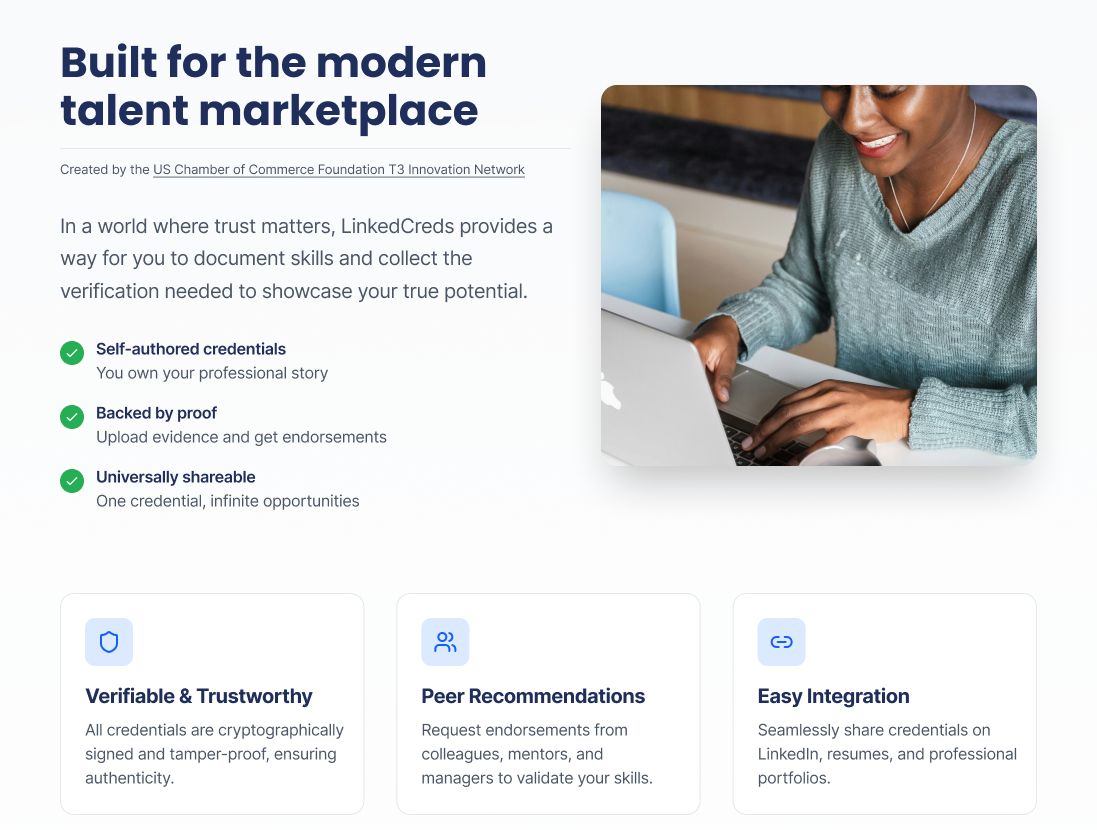
The U.S. Chamber of Commerce Foundation T3 Innovation Network, whose mission is to accelerate the use of digital tools to make the job market more fair and inclusive.
What We Did
AI skill extraction, design, requirements refinement, user testing, collaboration with technical partners to align on credential types, user flows, rendering strategies.
Outcomes
A working POC for showcasing how to create a self-issued verifiable credential, link evidence to it, and collect recommendations to strengthen the value.
Working at the intersection of product design, user research, data modeling, AI, and narrative storytelling, we conceptualized the design, user experience, and AI skills extraction to help users claim a skill. It was important to us that the technical details remain invisible to the user while also providing a way for them to opt out of AI inferred skills, or explicitly accept them. We also mapped each skill, whether user-entered or inferred by AI, to O*NET, a skills ontology. This enabled us to link skills to occupations and SOC codes while also enabling skill-level endorsements from 3rd parties.
We focused on making the creation and sharing of credentials feel as familiar as filling out a simple form. Our goal was to ensure that people understood the app and could build a credential in just a few minutes through simple, flexible workflows.
Built with data sovereignty in mind, LinkedCreds allows users to store credentials in their own Google Drive account, so they have complete control of their data. Integration of wallet-attached storage is coming soon to allow users to save credentials in any location of their choosing.
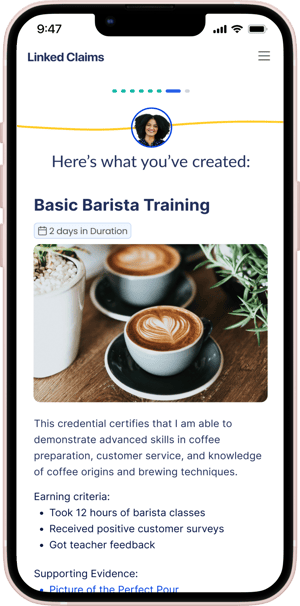
.png?width=300&height=647&name=LinkedCreds%20Recommendation%20Expanded%20(mobile).png "An image of a mobile webpage showing recommendations attached to a verifiable credential in the LinkedCreds app")
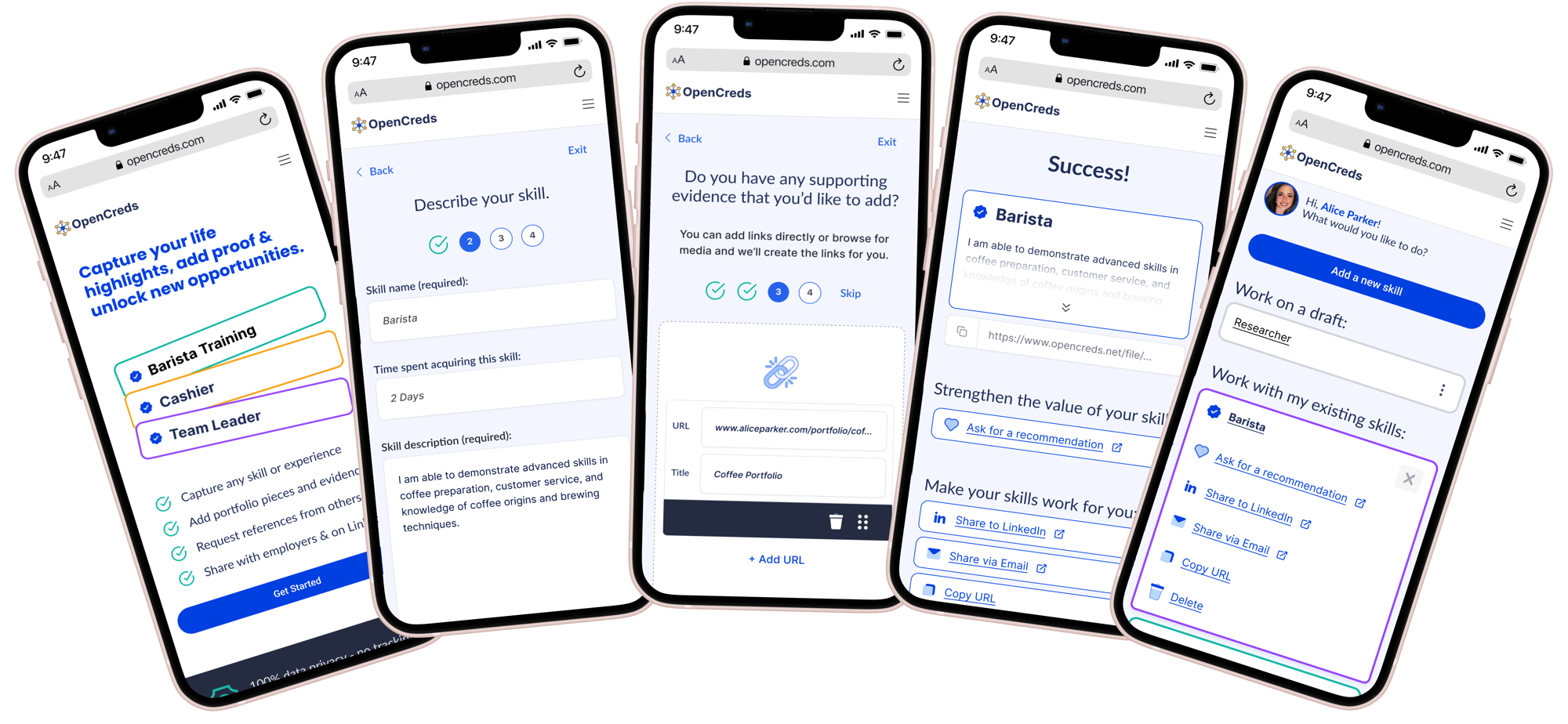
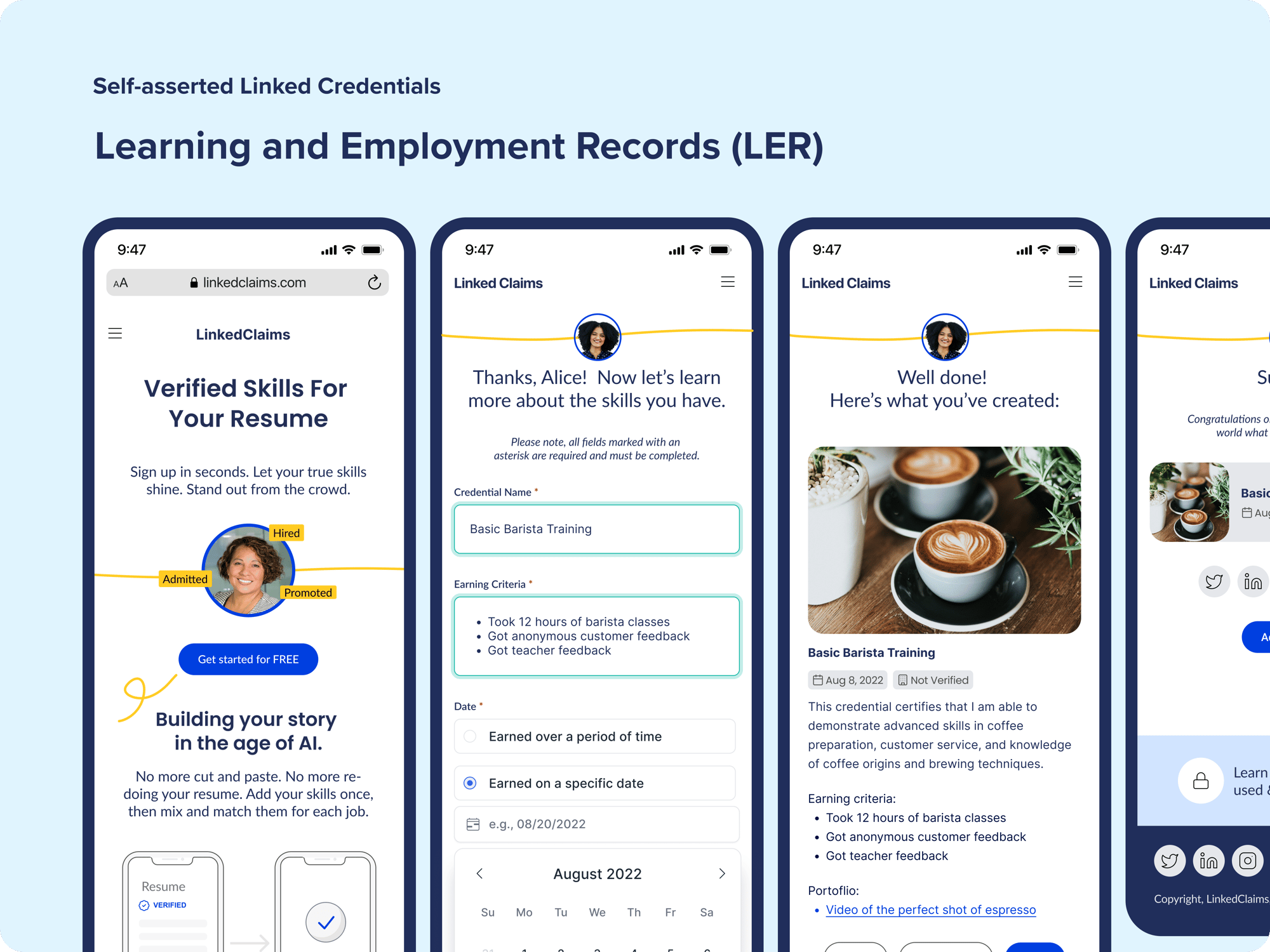
Figure 1. initial designs for responsive web app
FEATURES
Claim a Skill and Add Evidence to Create a Verifiable Credential (VC)
LinkedCreds makes it easy for anyone to document what they know, whether they learned it on the job, in a classroom, or through lived experience. With just a few steps, users can self-claim a skill, explain how they acquired the skill, and attach supporting evidence such as documents, images, links, or feedback from others who have observed their skills. Once complete, the claim is saved as a verifiable credential in their Google Drive account.
This approach helps credential the uncredentialed by expanding credentialing beyond degrees, certifications, and other formally issued records. A skill developed through years of work, caregiving, volunteering, independent learning, community involvement, or a specific project can be documented and supported with evidence. LinkedCreds gives people a structured way to capture those experiences and turn them into portable, machine-readable records of what they can do.
Because the credential is based on verifiable credentials and open standards for linked data, the information is more rich than a traditional resume and isn't locked into a proprietary profile on a third party application. Users retain complete control over their claim and their data and are able to build a collection of skills and experiences they can carry with them and share with others.
The design also accounts for important trust signals, such as evidence, to add context and credibility without requiring a school, employer, or platform to be the original issuer.
Add Recommendations to Any VC
LinkedCreds makes it easy to enhance any verifiable credential by attaching trusted recommendations. Whether you’ve claimed a skill like “Barista," an experience like volunteering, or on-the-job training, you can request and link recommendations from people who know your work.
Each recommendation includes:
-
The recommender’s name and relationship to the user
-
A short testimonial written in their own words
-
Optional supporting evidence, such as a signed letter or document
-
A digital signature that anchors the recommendation to a trustable source
This helps increase trust in self-asserted credentials and provides added context for hiring managers, educators, and reviewers who want to know not just what you did, but who can vouch for you.
Designing the future of skills based hiring?
Book a call to find out how we can help you.