
Modernizing Skills Assessments
Case Studies > Muzzy Lane
About The Project
Ideation Workshops Design Prototyping User Research Design System Creation
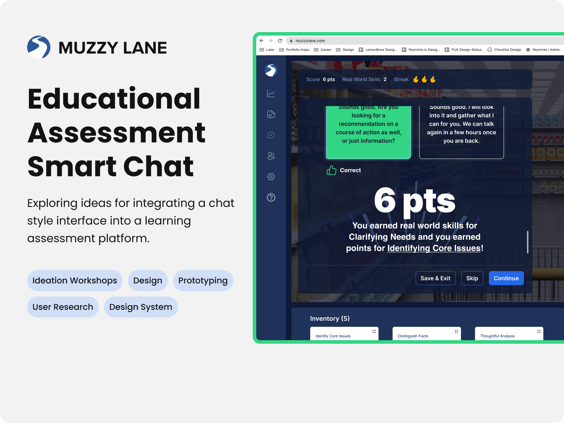
Muzzy Lane wanted to explore how AI-assisted interactions and gamification could improve the user experience of assessment takers in their chat-based assessment tool. Chat-based assessments are generated based on assessment logic created in the Muzzy Lane authoring tool. During assessments, users are presented with scenarios in a chat-style interface that require judgement-based decisions so they can prove their knowledge. While the underlying technology is powerful, Muzzy Lane saw an opportunity to explore modernizing the learner experience.
The goals were to:
- Modernize the interface
- Improve overall usability
- Reduce friction throughout the assessment experience
- Explore opportunities for AI-assisted interactions
- Introduce gamification concepts
- Create a scalable design foundation for future product development

"We had so much fun on this engagement. It required our team to understand the complete Muzzy Lane assessment ecosystem from content authoring through learner delivery. The work combined systems thinking, interaction and gamification design, research, accessibility, design systems, and usability testing to generate ideas designed to evolve rather than simply look modern. Our team couldn't get enough of the creative explorations we were encouraged to pursue by the Muzzy Lane team." —Karen Passmore, CEO, Predictive UX
The Work by the Numbers
242
screens designed
1,718
design component variants
Our Approach
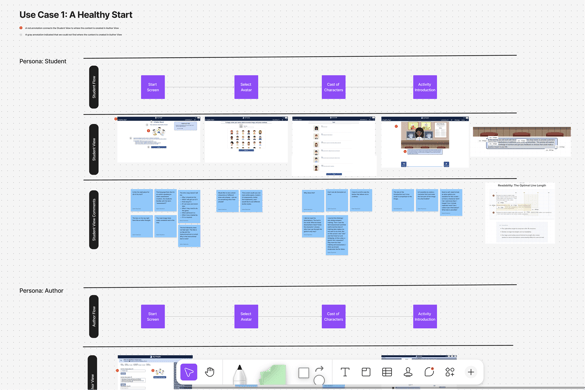
Rather than redesigning individual screens, we began by understanding how the entire platform functioned.
Our team conducted a comprehensive review of the existing product, including:
- Understanding how assessments were authored
- Mapping user workflows
- Reviewing competitive products
- Evaluating strengths and weaknesses across the experience
- Identifying usability issues through heuristic evaluation
This research informed multiple rounds of UX exploration before visual design began.
Client
The US Chamber of Commerce T3 Innovation Network whose mission is to accelerate the use of digital tools to make the job market fairer and more inclusive.
What We Did
Led design and requirements refinement, collaborated with technical partners to align on decentralized storage, wallet integration, and credential rendering strategies.
Outcomes
A working POC with wallet-attached storage and a custom UI for linking verifiable credentials supported by a decentralized data model and resume rendering framework.
Delivery Time
12 weeks
Design Exploration
Rather than pursuing a single concept, we explored numerous interaction models before selecting the strongest direction.
Across the project we produced:
| Design Phase | Screens |
|---|---|
| Final Design | 64 |
| Dark Mode Prototype | 80 |
| Design Editing Lab | 49 |
| UX Explorations | 42 |
| Inspiration Boards | 28 |
| Avatar Explorations | 3 |
| Layout Explorations | 9 |
Total: 275+ design screens
This extensive exploration allowed stakeholders to evaluate multiple interaction patterns before implementation.
Building a Scalable Design System
As the interface matured, we developed a comprehensive design system to ensure consistency and a re-usable foundation across the product while accelerating future development.
The resulting design system included:
- 74 component sets
- 1,718 component variants
- 311 standalone reusable components
- 2,029 total component nodes
The system covered virtually every aspect of the interface, including:
- Avatars
- Badges
- Buttons
- Chat Components
- Checkboxes
- Dropdowns
- Icons
- Inputs
- Inventory Components
- Messaging
- Modals
- Navigation
- Pagination
- Progress Indicators
- Toggles
- Tooltips
The engagement resulted in:
- A fully redesigned chat-based assessment experience
- Modern interaction patterns
- AI concepts
- Gamification concepts and flows
- A validated user experience through usability testing
- A comprehensive design system
- High-fidelity prototypes ready for next steps
Does your education application need modernization?
Book a call to discuss your needs.
Time to Proof
Reduces time-to-proof by enabling users to link verifiable credentials (VCs) directly to resume content, replacing vague claims with validated evidence.
Increased Trust
Increases trust by anchoring self-asserted skills and experiences to endorsements, digital signatures, and credential metadata - proving resumes are human, not AI.
Equitable
Empowers underserved job seekers, including career-switchers and those without traditional degrees, to represent their skills with credibility and control.
Data Sovereignty/Portabilty
Enables portable, user-owned resumes that live beyond a single job platform—supporting decentralized storage and selective sharing for data sovereignty.